Upcoming show
Madness & Practice
Duo Show: Liz Dawson and Lucy Teasdale
Axel Obiger
Opening: 7pm, 16th January 2026
Axel Obiger, Raum für zeitgenössische Kunst, Brunnenstrasse 29, 10119 Berlin
Opening times: Thu – Sat: 3 – 7 pm, and by appointment.
With Madness and Practice, painter Liz Dawson and sculptor Lucy Teasdale present new works that stage a quiet conflict between apparent intuition and rigorous construction. The title suggests a persistence that may register as futile or even obsessive, but is in fact an unflagging attentiveness to process, repetition, and control. Throughout the exhibition, surfaces and gestures promise immediacy while quietly betraying the labor and artifice beneath them. The works posit that this persistence is not a symptom of irrationality, but its inverse: practice – understood as sustained, almost ritualized work undertaken in pursuit of a particular kind of virtuosity.
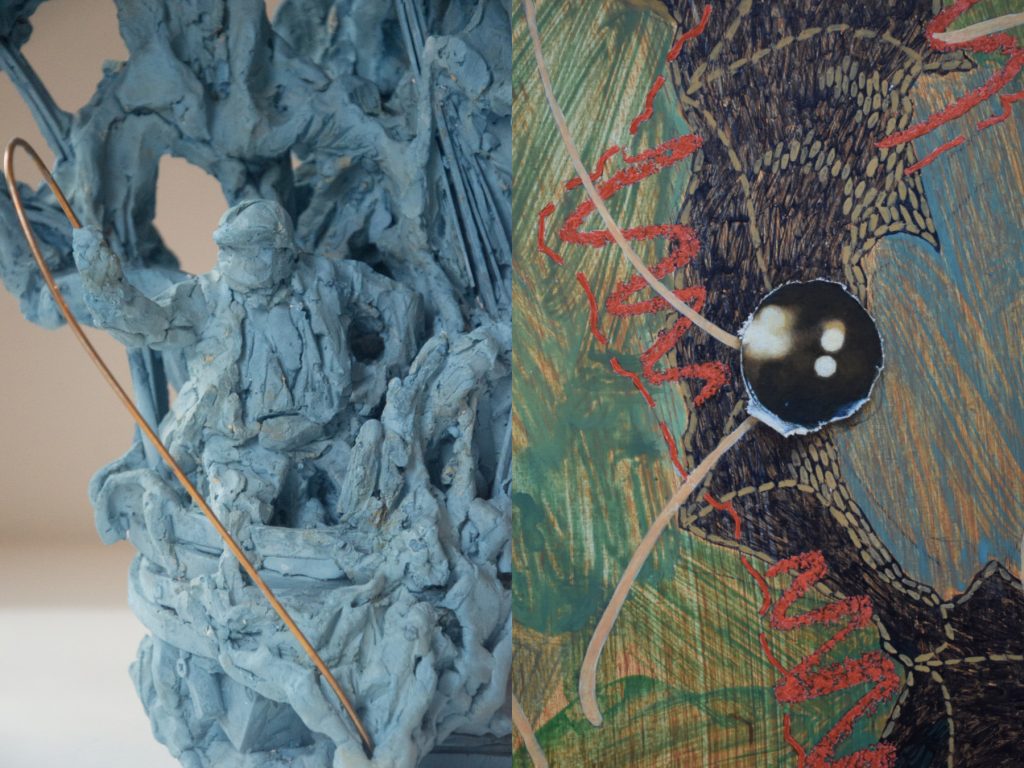
The works are indeed that – virtuosic. Liz Dawson’s paintings and drawings initially present themselves as enigmatic systems: arrows that double back on themselves, looping gestures, directional marks that feel both instructional and opaque. They resemble notations without a clear key – somewhere between a poet’s marginalia and a dancer’s shorthand for movement.
There is an apparent urgency to the mark-making, a sense of speed or immediacy. And yet this urgency is deceptive. What seems like a quick, expressive stroke often reveals itself, on closer inspection, to be painstakingly built from countless minuscule painted marks. The spontaneity is staged; the immediacy is manufactured. Dawson’s paintings operate through layered artifice,withholding information in order to draw the viewer in, only to confront them with an insistent specificity.
In Lucy Teasdale’s sculptures, vignettes of figures situated within constructed environments register as quickly made, caught mid-process, or held together precariously. Dripping, sagging, or splintered surfaces are rendered in playful, almost childlike colors, lending the works an initial lightness that suggests softness and reworkability. On closer inspection, however, this assumption gives way: what reads as malleable clay is in fact cast resin. Gestures that imply immediacy – impressions, folds, a tactility of touch – are fixed, their apparent openness resolved into permanence. As with Dawson’s paintings, movement, action, or narrative is proposed without being fully delivered. What is implied is never quite embodied.
Both artists work through a process of selecting something that resonates and committing to it fully. For Dawson, this might be a fragment of an image – often sourced from mass media – that begins to operate symbolically through repetition and directional marks. For Teasdale, it might be a photograph or a remembered scene: a pastoral image of a fisherman on a riverbank in England. These scenes carry with them the visual language of something given or authentic. Yet they are already mediated, already constructed – images shaped by history, projection, and expectation.
What emerges across both practices is a shared interest in fiction: not fiction as narrative, but as fabrication. Nature, spontaneity, intuition, even madness appear here not as raw states, but as carefully constructed propositions. At a moment when distinctions between authenticity and simulation are increasingly unstable, these works demand an engagement that isn’t about immediate verification or resolution, but rather about the pleasure of recognizing fiction at work. Meaning is neither given nor guaranteed. The work asks to be met halfway. Practice, here, extends beyond the studio and into the act of looking itself.
Text: Ilyn Wong